Reponse to Hockey Canada’s code of conduct decision
An independent Hockey Canada appeal board has confirmed that five of its 2018 world junior players breached its code of conduct, according to a report published August 12, 2026 by TSN’s Rick Westhead.
This report also revealed a text exchange between two players that was not included at trial.
Much of the conversation around these developments has focused on Hockey Canada, the five players, their suspensions and information the criminal court never heard.
But we keep coming back to E.M.
Too often, the survivor disappears from the story.
She testified for days. The most intimate details of her life were examined in a courtroom and reported across the country. Her memory, her actions, her words and her credibility were picked apart publicly.
The judge found E.M.’s evidence neither credible nor reliable, and all five men were acquitted. In the court of public opinion, that ruling quickly became something broader: proof, to some, that E.M. had lied and that nothing happened.
When the five accused were acquitted, the legal finding that the Crown had not proven its case beyond a reasonable doubt quickly became something much bigger in the court of public opinion.
E.M. was called a liar. She was called a whore. She was mocked, attacked and humiliated. And today she still suffers this abuse online.
People said the acquittals proved nothing happened.
Now, we know that Hockey Canada's separate disciplinary process considered additional information the criminal court did not hear.
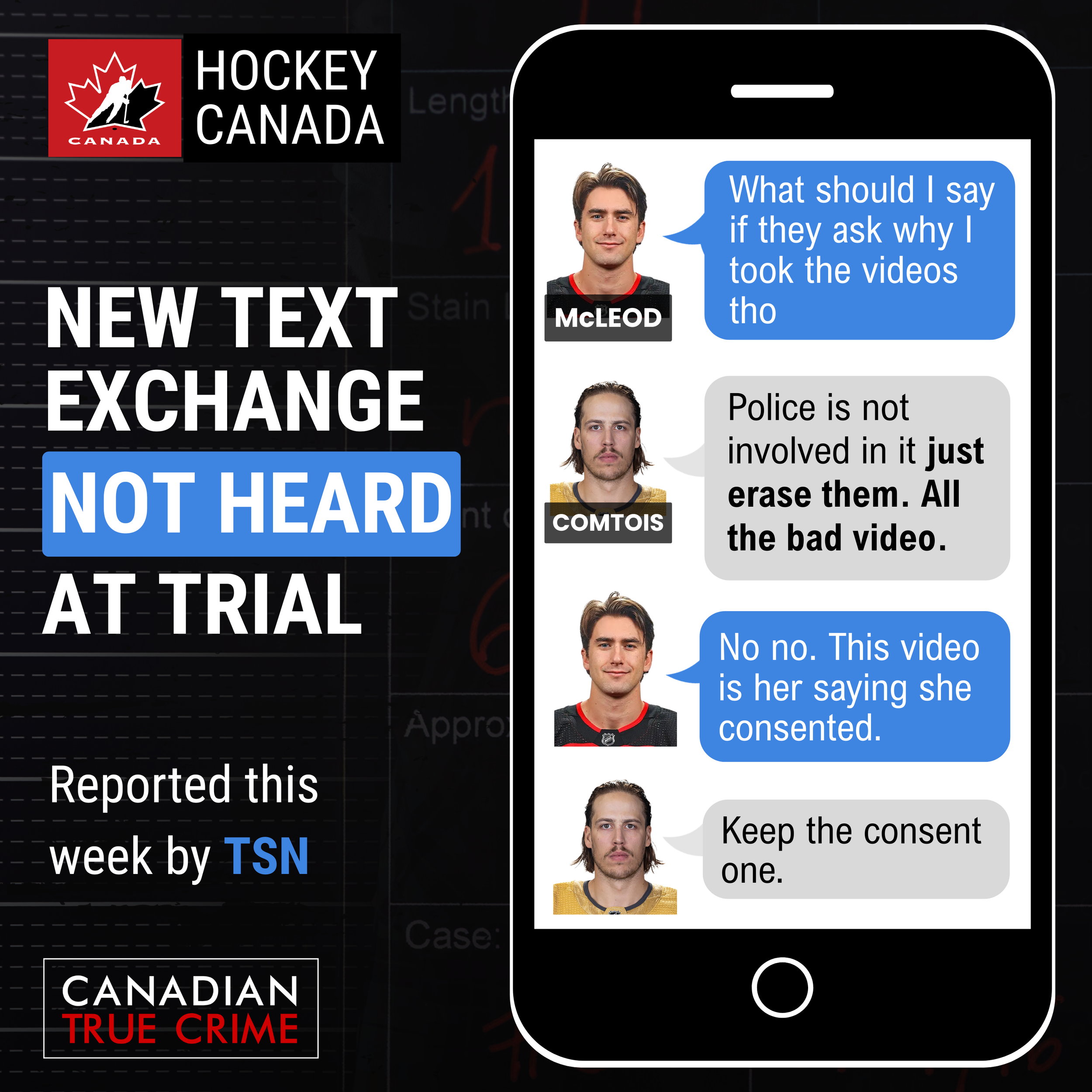
It included a fuller exchange between Michael McLeod and teammate Maxime Comtois after they learned there was an investigation:
McLeod: “What should I say if they ask why I took the videos tho”
Comtois: “Police is not involved in it just erase them. All the bad video.”
McLeod: “No no. This video is her saying she consented.”Comtois: “Keep the consent one.”
The existence of a “bad video” has not been proven - perhaps for obvious reasons.
But the exchange itself is significant.
It shows the players discussing deleting a “bad” video while keeping the one they believed proved E.M. consented.
Hockey Canada's disciplinary process ultimately determined that all five players breached its Code of Conduct. That finding has now been confirmed by an independent appeal board composed of three former judges.
None of this overturns the acquittals. Nor does it mean that a disciplinary finding is equivalent to a finding of criminal guilt. It means something much simpler, and incredibly important, and something we have been talking about for well over a year on this case now:
A criminal acquittal does not mean nothing happened.
It means the Crown did not prove a criminal offence beyond a reasonable doubt.
The criminal justice system does not have a monopoly on determining whether harmful or unacceptable conduct occurred. It is not the only process capable of examining conduct. Different processes ask different questions, apply different standards and, as we now know in this case, may consider different information.
We wish that distinction had been remembered before E.M. was subjected to the cruelty she experienced after the verdict.
Because behind the headlines, court decisions and hockey careers is a woman who had to watch strangers debate whether she was telling the truth about one of the most intimate and painful experiences of her life. E.M. deserved humanity then just as much as she deserves it now.
And to every survivor who watched what happened to E.M. and wondered what would happen to you if you reported: we see you and we understand why this scares you.
And we will keep fighting for a system, and a culture, that understands an acquittal is not permission to destroy the person who came forward.
- Kelly, Jess and Kristi
BEYOND THE VERDICT